


26 February 2026
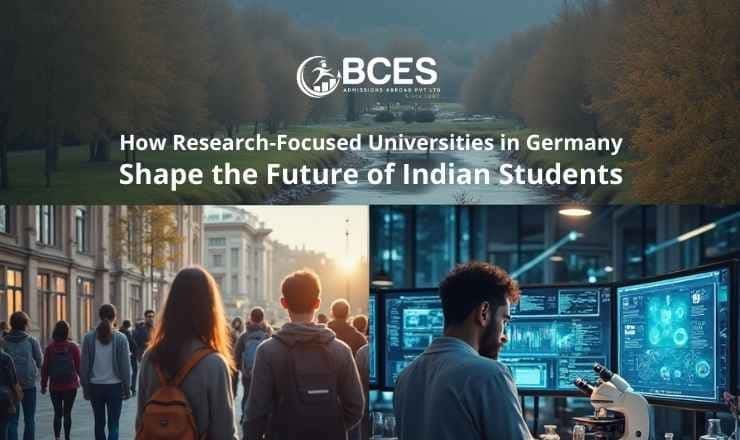
Do you have an idea about the increasing number of Indian students pursuing their higher education in Germany instead of looking at other common alternatives? The solution to this question lies within the German University system, where it is about more than just academics; it’s about discovering, inventing and then applying concepts through a real-world view as part of a Research-Based Learning system.
Germany has begun to be a destination for many of these students; they are not only looking for knowledge, but also seeking to gain skills needed to compete in the global marketplace. The structure of the universities in Germany encourages the development of curiosity and allows students to explore their ideas through Research-Based Education rather than just memorization.
In addition, the German education system has introduced several new educational policies and incentives that will foster more innovation in the areas of Artificial Intelligence, Sustainability and Digital Technologies in the last several years. Multiple institutions of higher learning including but not limited to Technical University of Munich and Heidelberg University have substantially increased their capacity for research, in order to keep up with changing global technology trends and advancements. As a result, the Indian student studying in Germany is being taught the newest information available as well as the current research trends related to that information.
The main reason why Study in Germany programs are so effective is that they offer the best combination of academics and industry experience. German universities are connected with industries to provide students with hands-on experience in addition to academics. Generally, students who study STEM-related disciplines in Germany are hands-on with the real world by working on case studies and research projects that are based on actual industry needs.
Not only do students attend lectures, but also experiment, innovate in labs, attend seminars, and participate in projects that incorporate applied learning, which allows students to see how concepts apply in the actual world; thus they gain confidence and analytical skills for Indian students who study abroad.
In addition to providing such benefits to students, Germany has a strong reputation for having modern research facilities. Many universities are affiliated with highly regarded institutions, such as the Max Planck Society, or the German Research Foundation (DFG), that promote innovative research and academic research and development. Students are introduced to a scholarly environment that has state-of-the-art research centres and research incubators.
The research-oriented environment of many German universities creates an environment that fosters innovation in education through facilitating an environment where students can explore, research, and develop solutions to problems. Similarly, faculty members are practising researchers which allows students to learn from contemporary research rather than past methods. The relationship between the innovative educational environment and the outstanding quality of German universities has led to German universities becoming recognised as leading institutions worldwide.
The research-oriented approach of German universities attracts Indian students who are planning their academic future. Research-oriented education is not limited to the current academic curriculum but also provides a future direction for students who are planning to pursue higher education like a PhD or any other advanced course in the future. Apart from academic purposes, research-oriented education also provides Global Career Opportunities because research experience and the ability to solve problems independently are highly valued by employers.
Recently, Germany has been focusing on digital transformation and sustainable research fields. German universities are modifying their academic curriculum according to global innovation trends, making research-oriented education even more attractive for international students.
At BCES Admissions Abroad, we help students understand how a research-oriented academic system can help them plan their future. Germany provides a platform where students can think independently and make genuine contributions to innovation. Contact us today at +91 9319996330 to begin your journey towards a research-oriented international education in Germany.