


11 February 2026
Ever notice how confident, outspoken, and self-assured Indian students appear after returning from studying in the UK? It’s probably due to their time spent abroad, but it may also be because UK classrooms provide opportunities for students to develop their confidence, often without them realizing it! Most Indian students find that their confidence grows as a result of frequent classroom discussions.
To begin with, it can be difficult to speak out in a UK classroom. There are new accents, new ways of teaching, and the fear of making mistakes that cause Indian students to remain silent. The UK universities employ a teaching style that does not penalize students for making mistakes or attempting to say something in English, so these students quickly realize that their focus should be on participating through providing ideas, rather than on providing a perfect English response. These students were thus given a great boost of confidence because of the teachers’ methods.
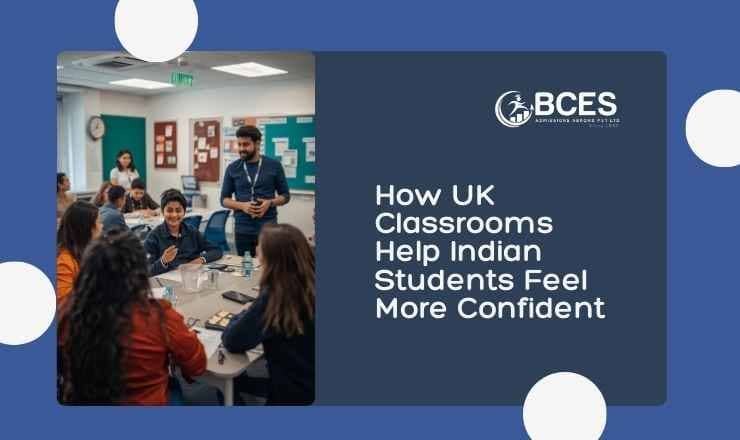
The educational approach taken by UK universities places a heavy emphasis on learning through discussion. The ethos of most Indian classrooms is that the teacher gives lectures to provide information to the students. Compared to Indian classrooms, UK classrooms place greater emphasis on encouraging discussion and giving students a chance to share their opinions, leading Indian students to build their confidence by being able to share their thoughts in a non-threatening, supportive, and respectful environment. With enough time, Indian students will become confident – something they did not have prior to coming to the UK.
Discussions are productive because they contain a variety of viewpoints. An Indian student’s view is largely influenced by their culture, prior experiences, overall education and personal history. The teacher who understands and values diversity will create self-esteem in his/her student’s population. In order to instill self-esteem, it is essential for teachers to listen to their students in an appropriate manner on a continual basis.
Participating regularly in classroom discussions further develops the communication skills of the Indian student. The seminar and group activities allow students an opportunity to question, clarify, and respond to their peers. In addition to providing students with the chance to practice their communication skills regularly, they will also have an opportunity to improve their public speaking abilities through repeated practice. Many Indian students become highly skilled public speakers, even though they may have been very quiet before.
Recent changes in educational practice suggest an increased emphasis on interactive learning within the UK’s academic institutions. With the return to on-campus learning, the use of small discussion groups, the use of seminars and learning through participation will become more frequent within classrooms, thus making learning more accessible and supportive of Indian students and giving them a place to actively engage and develop their self-confidence more quickly than in the past.
Teachers also play an important role in supporting Indian students. UK teachers are trained in ways to facilitate classroom discussions in a more balanced and fair manner, encouraging some students while not putting pressure on others to catch up. The provision of constructive feedback allows Indian students to learn how to improve, without feeling discouraged. This supportive atmosphere helps learners step out of their comfort zone naturally.
There is much more at stake than simply grades with the value of talking things through in class. In the UK, students that feel secure in their skill set when in an academic environment gives them the chance to better prepare themselves to enter into a globalised economy, with the ability to work collaboratively through teamwork and share their ideas freely with others. This is one of the reasons why students from outside of the UK choose to attend school in the UK to earn their degrees.
At BCES Admissions Abroad, we see the development of students on a daily basis through these types of group discussions. Not only will a student’s ability to communicate improve but also their mindset, their independence, and their faith in themselves. Through the confidence gained through studying in the UK, our students have benefited from the development of this confidence in both their personal lives and their professional careers. For personalized advice and expert guidance regarding admissions to the UK and beyond, BCES Admissions Abroad is at your service. Start your journey to global confidence and success today!