


19 February 2026
Have you ever felt that the educational system doesn’t really test your knowledge, and that the way to achieve good grades is to just memorize everything? In particular, the majority of educational institutions in India provide good grades based on rote memorization unless you’re doing it the right way! You probably didn’t realize that there are other ways to look at education besides simply putting in place a rigid system of grading (whereby one achieves a fantastic grade by knowing what you learned). The question then becomes, what would education look like if we had the possibility to think critically, truly solve problems that exist in ‘real life’, and apply knowledge that we have gained into actual situations in which we may find ourselves?
As part of the BCES Admissions Abroad program, we will assist Indian students in understanding how to achieve this move from simply learning by memory, and converting that into an actual understanding of what we’ve learned through the education you’ll receive in Germany. Studying in Germany through our program will allow you to be part of an educational process where logical thinking, the use of your own curiosity-based research, and solving problems will take precedence over simply memorizing definitions.
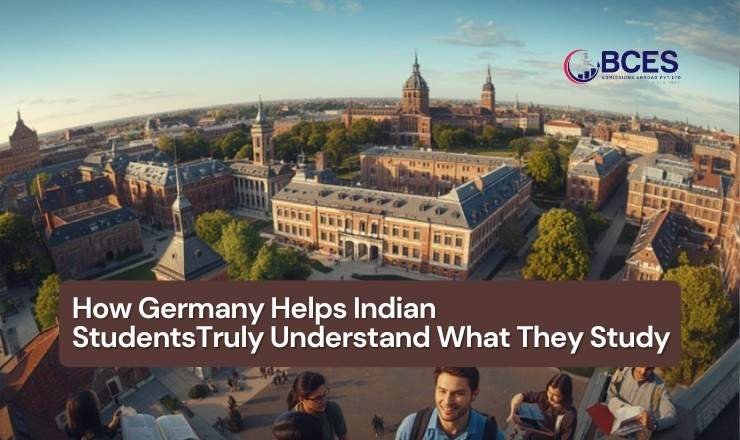
German universities differ from those in India. For example, the classroom in Germany is not just a place where there is a lecturer, his or her material, and a student simply listening, and recording. Lecturers in most German universities utilize a method of teaching in which students are encouraged to be active participants by challenging the lecturer’s viewpoint and by using the material discussed in class to relate what they are learning to the ‘real world’. There are times where a lecturer will ask a student for an example of a situation in which the student would apply what he or she learned in class. This method helps the student develop critical-thinking ability and to hone their confidence level concerning the knowledge they possess.
One of the main reasons why the German education system stands out in the global academic scene today is the emphasis on Research-Based Learning. This allows students to relate to the concepts they study and see how they are implemented in real-life situations. Recent updates show that the German education system has included more technology-based courses in their academic system, such as artificial intelligence, sustainability, and data analysis, to name a few, to keep the system at the forefront of educational innovation.
Another important feature of the German education system is the practical approach to learning, unlike the Indian education system, in which students are required to participate actively in the learning process, not just listen and memorize concepts and formulas.
Germany strongly advocates for Interdisciplinary Learning, where students are encouraged to explore other than their major area of study. For instance, a technology student could take a few courses in business management or sustainable development in addition to their major courses. This helps professionals become responsive to changing needs in their respective industries and think outside the box.
For Indian students, this new method of evaluation, moving away from written exams, will prove refreshing, where presentations, group discussions, and projects take precedence, helping students become better communicators and paving their way for success in the international arena.
At BCES Admissions Abroad, we will guide you through this transition from mere memorization to a more purposeful form of learning. We will help you grasp the concept of what to expect in the academic environment in Germany, so that you can easily adapt and get the most out of your academic experience. Get in touch with us and begin your journey into a world where learning helps one gain a better understanding, not mere memory.