


One of the issues faced in most countries is too few jobs, and too many people wanting those jobs. However, in Germany, it is an opposite situation where factories, hospitals and all other sectors need skilled workers, and there are too few people to take those jobs. The deficit grows every year. This is the reason why Ausbildung, the well-known German vocational training system, became the best option for those international students who want to build their careers in Europe.
But what sectors really need skilled workers nowadays? In this article, we will try to explain in easy words what sectors require the largest number of workers today.
Reasons Why Germany Lacks Skilled Workers
Demographic issues are one of the main reasons why Germany lacks skilled workers. Germans are aging, but the number of skilled workers is decreasing faster than the birth rate of young Germans. Germany has an export-oriented, technologically advanced economy, and it requires a highly skilled workforce to function efficiently. Moreover, Germany is experiencing a new digital revolution and a green transition. It makes the labour market incapable of satisfying its own needs.
The result? Hundreds of thousands of vacancies sitting unfilled across the country, even while companies actively search for talent. For ambitious students willing to train and work hard, this shortage is turning into a genuine opportunity.
Sectors With a High Demand for Ausbildung Graduates
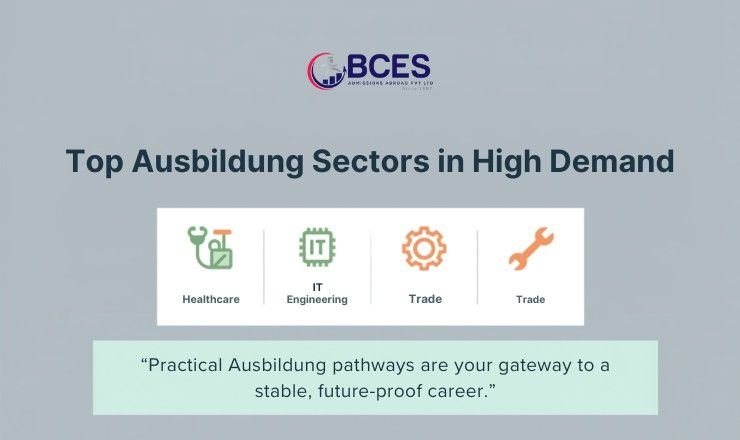
Healthcare and Nursing
One of the biggest problems in Germany is the lack of nurses and care professionals. It happens because the population of the country is aging but there aren’t enough people to provide medical care. Programs for nurse education (Pflegefachmann or Pflegefachfrau) are considered some of the most promising and reputable today and will be in high demand for decades.
Information Technology
Tech companies in Germany are rapidly growing and can’t recruit all the specialists they need. There is a high demand for software developers, network administrators, and information security specialists in Germany. The positive feature of the sector is that many positions give weight to practical skills and certifications at least as much as the academic one.
Engineering and Mechatronics
It’s hard to underestimate the reputation of Germany when it comes to engineering. But the reality is that there is a deficit of technicians who work in electrical engineering, mechatronics, and industrial mechanics. A significant part of open technical positions is in shortage of candidates. If you like working with machinery, technologies, and systems, the engineering sector may offer you career security.
Electricians, plumbers, heating and air conditioning technicians, and construction workers make up the core of Germany’s Handwerk. With the ongoing process of energy transition and its many facets – from solar panels and heat pumps – demand for those skilled professions continues to grow. Ausbildung programs in skilled trade fields provide practical knowledge and are well-paid and open doors straight into employment.
Logistics and Transport
Germany’s central position in European trade makes the continuous movement of goods through and across the country inevitable. Warehousing, freight and transportation companies have trouble finding enough qualified people, therefore making logistics an area of consistent growth and a reliable job option for students who have completed Ausbildung.
Renewable Energy
With Germany’s accelerated shift towards green energy, the need for specialists working with solar and wind power grows fast. This is a relatively new profession, so students eager to learn can have a great chance to build a prosperous career without having previous work experience in this field.
Implications of a Shortage of Skilled Workers for International Students
The signal coming out of Germany’s labour market is unambiguous. Well-trained specialists are in great demand, and Ausbildung is the road to becoming one. As opposed to purely educational qualifications, the programme of vocational training includes classroom education and practical training at work, providing its participants with hands-on experience and the opportunity to obtain a state-recognised certification that guarantees access to job after the training.
Students who have doubts regarding the feasibility of choosing the vocational route in Germany should take into consideration the following facts: such sectors as healthcare, IT, engineering, trades, logistics and renewable energy industry are not only hiring, but desperately looking for skilled staff.
Conclusion
The shortage of skilled workers is a trend that will persist for a long time due to demographic changes and the economic development of Germany. Students willing to build a solid career in another country will have the opportunity to choose a profession in demand in Europe in case they will opt for one of the sectors of Ausbildung.
At BCES Admissions Abroad we assist our students in choosing the appropriate programme of Ausbildung according to their personal and professional interests.